Mild Hybrid Systems (MHEV) of 48V: What changes in the battery?
Understand how 48V mild hybrid systems (MHEV) work, their interaction with the traditional 12V battery, and the electrical care these cars require.
Mild Hybrid Systems (MHEV) of 48V: What changes in the battery?
The automotive market is undergoing one of the greatest transformations in its history, driven by the search for higher energy efficiency and lower pollutant emissions. Among the technologies gaining the most ground in Brazil and worldwide is mild hybridization, known by the acronym MHEV (Mild Hybrid Electric Vehicle). Unlike full hybrids, the MHEV stands out for offering a more accessible production cost and excellent adaptability to existing flex-fuel engines.
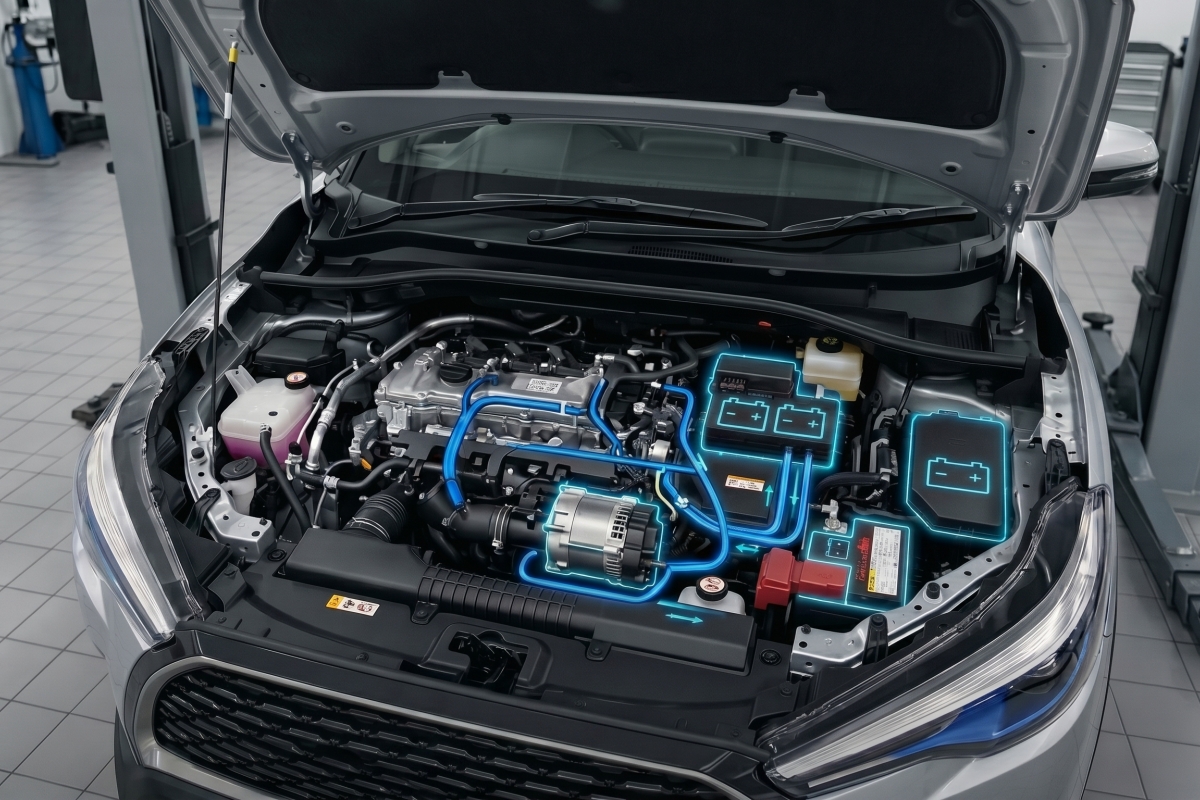
In these vehicles, the traditional 12V electrical architecture begins to coexist with a parallel high-voltage network, usually operating at 48V. This structural change completely alters the operation of the starter motor and alternator, creating new demands for energy storage and requiring batteries capable of withstanding extremely dynamic charge cycles.
What is mild hybrid technology (MHEV)?
Mild hybrid systems utilize a small auxiliary electric motor that acts as a generator, providing extra torque to the combustion engine and saving fuel.
The electric motor in an MHEV system is not designed to drive the vehicle entirely on its own over long distances, but rather to support the thermal engine during high-effort moments, such as starting from a stoplight and overtaking. It also handles the ultra-fast restarting of the engine when the Start-Stop system is triggered.
The main benefits of this technology are:
- Immediate reduction of up to 15% in CO₂ emissions and fuel consumption
- Support during acceleration, improving torque responses at low RPMs
- Smooth shutdown of the combustion engine before the vehicle comes to a complete stop (coasting function)
- Reduced mechanical wear on components such as the conventional starter motor
Important: Because it does not have an external plug (like plug-in hybrids), all electrical energy in the 48V system is generated autonomously by the car itself through kinetic energy recovery.
This point complements content regarding new vehicle electrification technologies.
Why do MHEV systems use a 48V architecture?
The 48V network allows more energy to be transported using thinner and lighter cables, while powering equipment that requires high wattage without overloading the 12V wiring.
In a conventional vehicle, powering heavy accessories like progressive electric power steering, high-performance air conditioning compressors, and active suspension systems under 12V would generate an extremely high electrical current. Raising the voltage to 48V reduces the current needed to achieve the same power, resulting in less heat loss and a boost in overall efficiency.
The technical advantages of this higher voltage architecture include:
- Lighter, smaller-diameter wiring for power distribution
- The possibility of electrifying the A/C compressor, keeping the cabin cool even with the engine off
- Faster responses from all active vehicle stabilization systems
- Easy integration with the existing combustion engine without deep structural changes
Attention: Although the main propulsion and regeneration network operates at 48V, internal control electronics, safety lighting, and infotainment systems continue to run on a parallel 12V network.
How does energy management work between the 12V and 48V batteries?
Mild hybrid cars feature two distinct batteries working in harmony through a direct current converter (DC/DC).
The 48V battery (usually lithium-ion) is responsible for storing the energy captured during braking and powering the high-output starter-generator. On the other hand, the conventional 12V battery (typically an EFB or AGM type) remains responsible for external and internal lighting, digital dashboards, electronic fuel injection modules, and passive vehicle safety.
The energy flow occurs as follows:
- The generator recovers kinetic energy and sends it to the 48V battery
- The DC/DC converter steps down the voltage from 48V to 12V as required
- The 12V battery receives a continuous charge to keep peripheral systems running
- In case of a failure in the 48V network, the 12V battery assumes basic safety control to allow a safe stop
This reasoning connects with content regarding the electrical complexity of vehicles with high-tech injection systems.
Why are high-performance batteries crucial for MHEV vehicles?
The 12V battery in an MHEV vehicle operates constantly under a highly fluctuating state of charge and requires excellent fast-charge acceptance.
Because the charge supplying the 12V battery comes from the DC/DC converter connected to the hybrid system, voltage fluctuations are far more frequent than with a conventional alternator. For this reason, batteries with EFB or AGM technology—featuring low internal resistance and high cyclic durability—are mandatory to keep the car's entire electrical ecosystem balanced.
Tudor batteries with EFB and AGM technologies are engineered to meet the strictest global automotive standards, offering exceptional robustness for hybrids and conventional Start-Stop cars alike. Their reinforced internal construction guarantees maximum efficiency in charge retention and resistance to continuous charge and discharge cycles.
Conclusion
48V mild hybrid systems (MHEV) represent a leap in electrical and mechanical sophistication that demands matching replacement components. The 12V battery plays a fundamental role in safety and stability, and neglecting its quality can deactivate the vehicle's eco-friendly and fuel-saving features.
With latest-generation Tudor batteries, your MHEV vehicle gets the right energy to deliver all the efficiency promised by the manufacturer. Discover the high-performance Tudor battery line and ensure superior durability for your electrified car.
Frequently asked questions about mild hybrid MHEV cars
Do mild hybrid MHEV vehicles have a plug to charge from the wall? No. The MHEV system is 100% self-charging, capturing energy that would otherwise be wasted during braking and deceleration, requiring no plugs or external chargers.
If the 48V lithium battery runs out, will the car still start using the 12V battery? Yes, the 12V battery provides energy for emergency starting and keeps crucial engine electrical modules active, though fuel-saving features will be temporarily suspended.
Which Tudor battery should I use for replacement in MHEV cars? You must use the exact technology specified by the vehicle manufacturer, which is typically a high-cycling Tudor EFB or AGM battery. Never use conventional lead-acid batteries in these systems.
Read also

What happens when a car sits unused for a long time?
Not every vehicle is driven long distances every day. Many people own a second car, use their vehicle only on weekends, or leave it unused during extended trips. Although this situation may seem harmless, long periods without use can directly affect the automotive battery. Even with the engine turned off, some vehicle systems continue to consume power, and the battery itself naturally loses charge over time. If this period is prolonged, the risk of discharge, sulfation, and reduced service life increases significantly. Understanding what happens when a car remains unused for a long time helps preserve the battery and avoid surprises when it is time to use the vehicle again.
Continue reading
Automotive battery and alternator: what is the relationship between them?
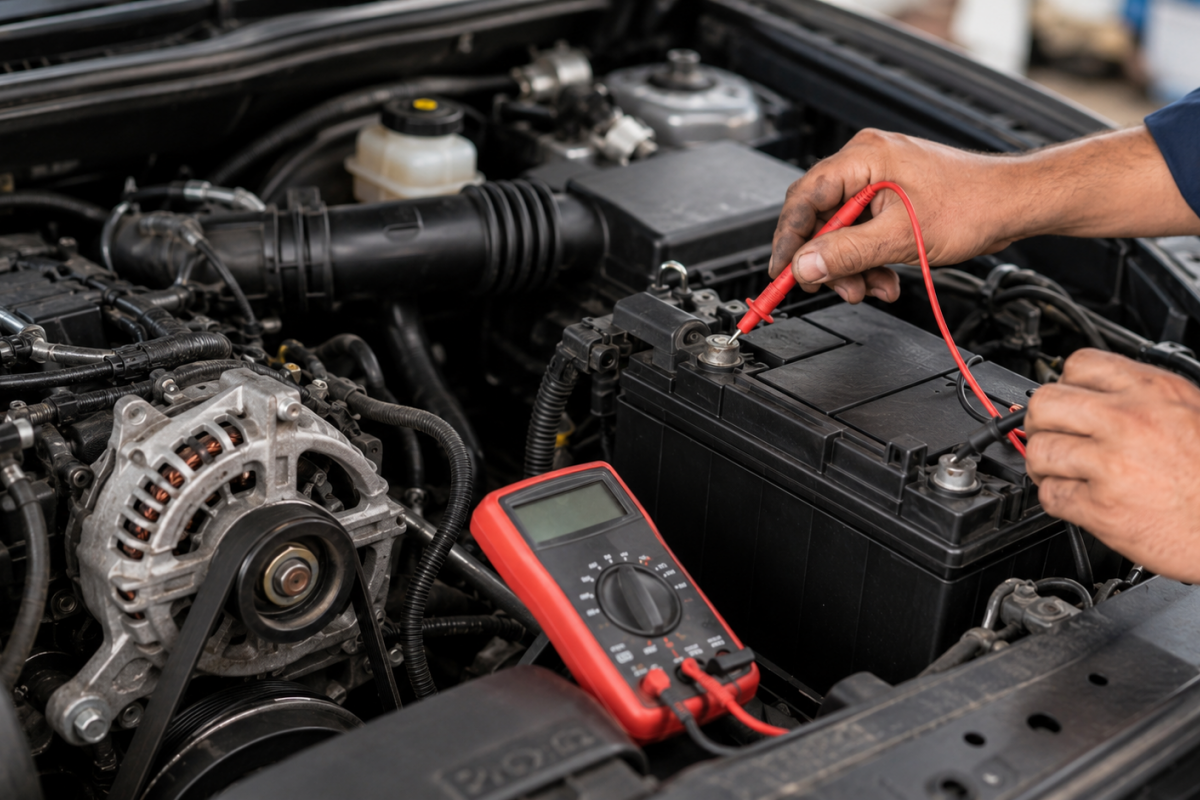
It is common for a driver to experience difficulty starting, find the battery dead, and quickly conclude that it is time to replace it. However, the problem is not always the battery. The battery and the alternator work together to keep the vehicle's electrical system running correctly. When one of these components fails, the other ends up being affected as well, which can generate very similar symptoms and make diagnosis difficult. Therefore, understanding how the battery and alternator work together is essential to identify the source of possible failures and ensure that the electrical system operates safely and efficiently. When the battery needs to be replaced, it is also important to check whether the charging system is operating correctly to preserve the performance of the new component.
Continue reading

How temperature influences the useful life of the automotive battery
The automotive battery is constantly exposed to different environmental conditions. In some regions, intense heat predominates for much of the year. In others, lower temperatures become a challenge for the vehicle's electrical system. Although many drivers associate battery problems only with usage time, temperature is one of the factors that most influences its durability and performance. Both excessive heat and intense cold affect the chemical reactions that take place inside the battery, accelerating wear processes and reducing its ability to supply energy.
Continue reading